

my home: Düsternbrook Safari Guest Farm, Namibia

The place I’m honoured to call home.

There are places you visit, and then there are places that become part of who you are. For me, that place is Düsternbrook. I partly grew up here, surrounded by the rolling hills of the Khomas Hochland, dry riverbeds, granite outcrops, and wildlife that was never something extraordinary, but simply part of life.
Every time I return, I’m reminded that this landscape shaped the way I see Namibia. When people ask me where my favourite place in the country is, I always hesitate for a moment because Namibia is full of incredible places. But if I’m being honest, it’s Düsternbrook. Not because it is more spectacular than Sossusvlei or Etosha, but because it is home.
Düsternbrook and the Khomas Hochland
Düsternbrook lies in the Khomas Hochland, a highland region west of Windhoek that forms much of the landscape around central Namibia. It is a rugged but gentle part of the country, with rolling hills, rocky valleys, dry river systems and wide-open views.
At around 1,500 to 2,000 metres above sea level, the air can be noticeably cooler than in many other parts of Namibia, especially in the evenings. After good rains, the dry riverbeds can suddenly come alive, while during the dry season the landscape takes on the colours and character that many people imagine when they think of Namibia.
It is one of those places where you can spend hours walking through the bush, watching giraffes move across a hillside, listening to birds along a dry riverbed, or simply sitting on a veranda with a cup of coffee.
The Khomas Hochland has never been about big spectacles for me. Its beauty is quieter than that.
A Family History That Goes Back to 1942
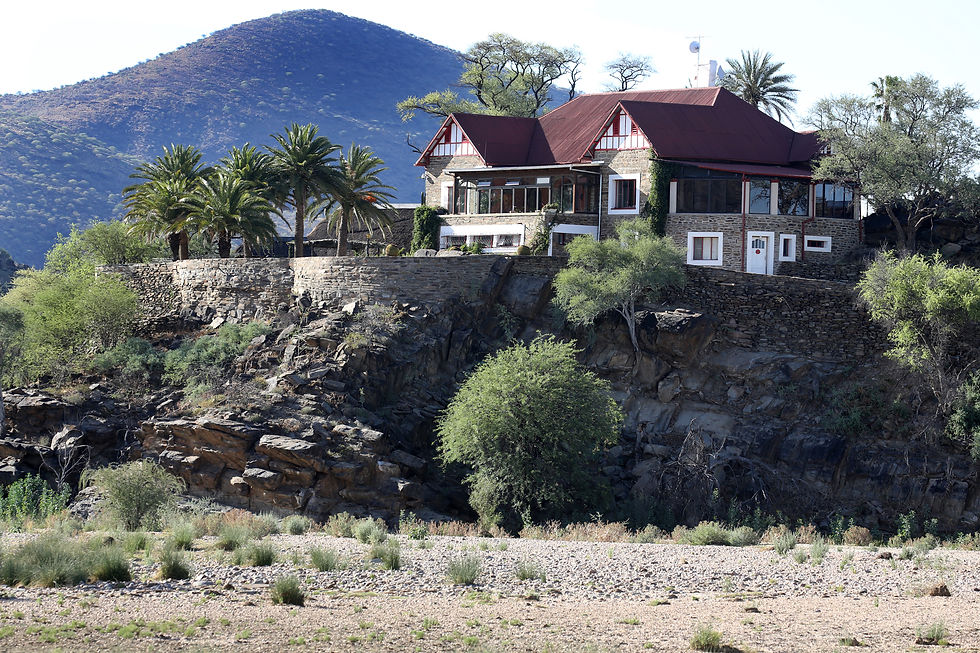
Düsternbrook has a long history, and that history is deeply personal to me. My family has been here since 1942, when Düsternbrook was still a traditional cattle farm. Long before tourism became an important part of Namibia, this was a working farm in the heart of the Khomas Hochland. In 1961, my grandmother, Marga Vaatz, had the vision of welcoming guests to the farm and transformed Düsternbrook into Namibia’s first guest farm. For that time, it was a remarkably forward-thinking idea. Wildlife was often seen as a challenge to farming, but she believed that nature could be protected while also being shared with visitors in a respectful and meaningful way. Later, my father, Johann Vaatz, continued to run Düsternbrook and shaped the farm for many years. Looking back, I think my family has often been ahead of its time, first by creating Namibia’s first guest farm, and later through a form of tourism that has always remained closely connected to nature.
Three Little Birds is my own way of carrying that story into the next generation. Through sustainable, personally designed journeys, I try to continue the values I grew up with at Düsternbrook: hospitality, conservation, and a deep connection to this country.
Today, Düsternbrook is still a family place. The old farmhouse, the riverbeds, the mountains, and many of the stories have remained. That is probably why our journeys with Three Little Birds Safaris begin here. I have found that Namibia is best experienced slowly. After a long international flight, there is no need to rush straight into the desert. Düsternbrook gives you space to arrive, settle in, and gently adjust to the rhythm of the country. Some guests spend the afternoon by the pool, others join a game drive, go horse riding, or simply sit on the veranda and watch animals move through the valley below. There is no pressure to do anything, and in my experience, that is one of the greatest luxuries of all.
Düsternbrook Safari Guest Farm: What to Expect
One of the things that makes Düsternbrook such a good first stop in Namibia is its location. It is only around 45 minutes from Windhoek, but once you leave the city behind, the landscape changes quickly. The road takes you into the Khomas Hochland, where dry riverbeds, rocky hills and open valleys replace the city.
For me, this makes a huge difference after a long international flight. There is no need to sit in a car for another five or six hours on your first day. You can arrive, have a good meal, take a swim, enjoy a drink on the veranda and let the journey begin at its own pace.
There are plenty of ways to spend your time here. You can join a game drive through the reserve, go horse riding through the dry riverbeds, or head out in the afternoon for our Sky Unlimited experience and watch the sun set from high above the farm.
And if you would rather do nothing at all, that is perfectly fine too. Sometimes sitting on the veranda with a coffee and watching what passes through the valley is all you need.
I usually recommend spending two or three nights at Düsternbrook at the beginning of a longer Namibia journey. One night works if you are travelling on a tighter itinerary, but if you have the time, I would always choose the extra night. Namibia is a country where the journey itself is part of the experience, and there is no reason to rush through the first few days.

One of the experiences I would highly recommend on Düsternbrook is horse riding. Early in the morning, you ride through the dry riverbeds and open bush while the light is still soft and the air is cool. On horseback, you become part of the landscape in a way that is difficult to experience from a vehicle. Wildlife is often surprisingly relaxed around horses, and encounters feel quieter and more natural. Whether you have never ridden before or have years of experience, there is something special about exploring the Namibian bush from the saddle. Afterwards, breakfast on the veranda somehow tastes even better.

If I had to choose another activity that captures the feeling of Düsternbrook, it would be Sky Unlimited. In the late afternoon, you head out on a relaxed game drive through the Khomas Hochland, keeping an eye out for giraffes, zebras, kudu, oryx, and many other species that call this landscape home. As the day begins to cool, the drive takes you up to a plateau with a 360-degree view over the surrounding mountains and valleys. That viewpoint is one of my favourite places on the farm because it has a way of putting everything into perspective. You sit there with a drink in hand, some snacks, and watch the sun slowly disappear behind the hills. There is rarely another vehicle, rarely another sound, just the changing colours of the landscape and the enormous Namibian sky. It is a simple experience, but those are often the ones that stay with people the longest.
What makes Düsternbrook different?
What many visitors do not realise is that Düsternbrook is not just a place to stay. It is a place that has evolved over generations. The former livestock farm gradually became a private nature reserve, where tourism helps protect wildlife, preserve the landscape, and maintain a way of life that is deeply connected to this part of Namibia. For me, that is not a marketing story. It is my family’s story. I grew up with the understanding that hospitality and conservation belong together, and that sharing a place with guests also means taking responsibility for it.

Frequently Asked Questions About Düsternbrook
How far is Düsternbrook from Windhoek?
Düsternbrook Safari Guest Farm is around 45 minutes from Windhoek, making it an easy first or last stop on a Namibia journey.
Is Düsternbrook a good place to stay when arriving in Namibia?
Yes. This is one of the main reasons I like starting our journeys here. After a long international flight, you can arrive without having to drive for hours, settle in and start experiencing Namibia straight away.
What can you do at Düsternbrook?
Activities include game drives, horse riding and the Sky Unlimited sundowner experience. You can also relax by the pool, sit on the veranda or explore the surrounding landscape.
Can you go horse riding at Düsternbrook?
Yes. Horse riding takes you through the dry riverbeds and surrounding bush and is suitable for different levels of riding experience.
What is the Khomas Hochland like?
The Khomas Hochland is a highland region around central Namibia, characterised by rolling hills, rocky valleys, dry riverbeds and wide-open landscapes. Its elevation also means that it can be cooler than many other parts of the country.
Is Düsternbrook suitable for a luxury Namibia safari?
Düsternbrook is different from a traditional luxury lodge. Its appeal comes from its history, setting and personal atmosphere rather than simply from luxury facilities. For me, that is exactly what makes it such a meaningful beginning to a Namibia journey.
Can you visit Düsternbrook without staying overnight?
Some activities can be arranged for visitors who are not staying overnight, depending on availability. However, I would recommend staying if your itinerary allows it. The best part of Düsternbrook is the slower pace of the farm and the feeling of having arrived in Namibia.
The Place I’m Honoured to Call Home
I have travelled to many beautiful places, and I know lodges that are more luxurious, landscapes that are more dramatic, and destinations that are more famous.
But Düsternbrook has something that cannot be built. It has history, it has family, and it has the feeling of a place that has been lived in, cared for and slowly shaped over decades.
When you arrive here, you are not simply arriving at a hotel. You are arriving at a farm that has welcomed travellers for more than sixty years.
And perhaps that is why I still enjoy coming back to Düsternbrook, even after growing up here.
It feels like home.


Comments